
is advocating for John Brown the same as advocating for violence?
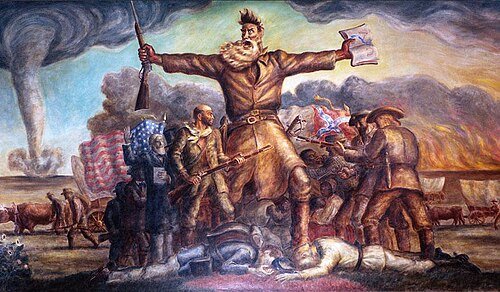
Tragic Prelude, painted in 1942 by the American artist John Steuart Curry for the Kansas State Capitol building in Topeka, Kansas.
The short answer to that question is “No.”
And we know that many will not bother using reason and will instead paint our movement as blood-thirsty, violent, or unAmerican. That’s why we put together this short statement about violence and the circumstances that led Brown to the gallows.
We do not advocate hacking people with broadswords in Kansas—or outside Kansas. In fact, we do not advocate violence at all. At the same time, we acknowledge that when people are brutally oppressed, we can not expect them to remain calm without defending themselves. Brown advocated that people under attack defend themselves. He was standing up to bullies more than 100 years before Andy Griffith told Opie that giving your lunchmoney to bullies isn’t going to work out like you hope it will, and there’s only one thing you can do: “punch him in the nose, Ope” Andy said.
Violent resistance was Brown’s last resort
As abolitionists and antislavery advocates exhausted every moral, legal, and democratic hope, Brown came to realize that violent white supremacists only respected one language: “Might makes right.” The Caning of Charles Sumner, The Sacking of Lawrence and other Bleeding Kansas violence made it clear. His last words at the gallows illuminate this understanding:
“I had vainly flattered myself that, without very much bloodshed it might be done…
I, John Brown, am now quite certain that the crimes of this guilty land will never be purged away, but with Blood”
This wasn’t a bloodthirsty call to arms, it was a hopeless admission that a democratic solution to this issue tore a nation in half was impossible. And he was right. The Civil War followed barely a year and a half later.
In his declaration of liberty, Brown wrote:
“...they have a perfect right, a sufficient & just cause, to defend themselves against the tyranny of their oppressors.”
America was built on the notion that you have the right to defend yourself against oppressors. It’s what his grandfather fought the Revolutionary War about.
An equally strong moral driver was Brown’s Christian focus on the Golden Rule, likely reasoning that “If I were enslaved, I’d want someone to help break me out.”
