
John brown’s final speech
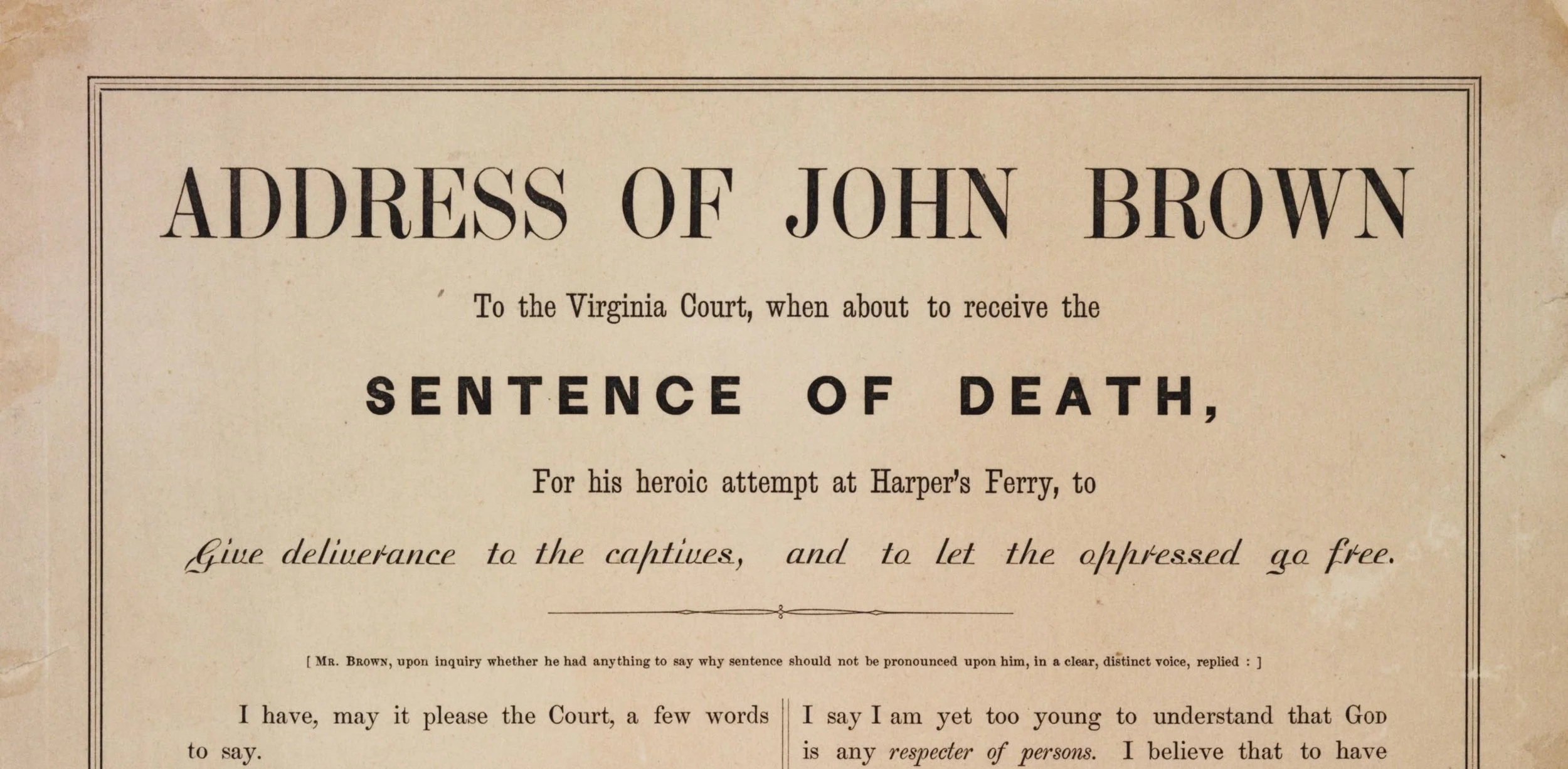
I have, may it please the Court, a few words to say.
In the first place, I deny every thing but what I have already admitted, of a design on my part to free Slaves. I intended, certainly, to have made a clean thing of that matter, as I did last winter, when I went into Missouri, and there took Slaves, without the snapping of a gun on either side, moving them through the country, and finally leaving them in Canada. I desired to have done the same thing again, on a much larger scale. That was all I intended. I never did intend murder, or treason, or the destruction of property, or to excite or incite Slaves to rebellion, or to make insurrection.
I have another objection, and that is, that it is unjust that I should suffer such a penalty. Had I interfered in the manner, and which I admit has been fairly proved, – for I admire the truthfulness and candor of the greater portion of the witnesses who have testified in this case, – had I so interfered in behalf of the Rich, the Powerful, the Intelligent, the so–called Great, or in behalf of any of their friends, either father, mother, brother, sister, wife, or children, or any of that class, and suffered and sacrificed what I have in this interference, it would have been all right. Every man in this Court would have deemed it an act worthy a reward, rather than a punishment.
This Court acknowledges too, as I suppose, the validity of the LAW OF GOD. I saw a book kissed, which I suppose to be the BIBLE, or at least the NEW TESTAMENT, which teaches me that, "All things whatsoever I would that men should do to me, I should do even so to them." It teaches me further, to "Remember them that are in bonds, as bound with them." I endeavored to act up to that instruction. I say I am yet too young to understand that GOD is any respecter of persons. I believe that to have interfered as I have done, as I have always freely admitted I have done, in behalf of his despised poor, I have done no wrong, but RIGHT.
Now, if it is deemed necessary that I should forfeit my life, for the furtherance of the ends of justice, and MINGLE MY BLOOD FURTHER WITH THE BLOOD OF MY CHILDREN, and with the blood of millions in this Slave country, whose rights are disregarded by wicked, cruel, and unjust enactments, – I say; LET IT BE DONE.
Let me say one word further: I feel entirely satisfied with the treatment I have received on my trial. Considering all the circumstances, it has been more generous than I expected; but I feel no consciousness of guilt. I have stated from the first what was my intention, and what was not. I never had any design against the liberty of any person, nor any disposition to commit treason, or excite Slaves to rebel, or make any general insurrection. I never encouraged any man to do so, but always discouraged any idea of that kind.
Let me say something, also, in regard to the statements made by some of those who were connected with me. I hear that it has been stated by some of them, that I have induced them to join me; but the contrary is true. I do not say this to injure them, but as regarding their weakness. Not one but joined me of his own accord, and the greater part at their own expense. A number of them I never saw and never had a word of conversation with, till the day they came to me, and that was for the purpose I have stated. Now I have done. –
John Brown
about this document
Spoken by John Brown, after having been found guilty, during the sentencing phase of his trial for treason on November 2, 1859. It appeared in full on the cover of major newspapers across the country the following day. William Lloyd Garrison published Brown’s speech as a broadside that he sold out of the office of his anti-slavery newspaper The Liberator in Boston.
In it, Brown denies the charges of treason and insurrection and simply claims to have desired to move the enslaved from bondage to freedom, as he had done in Missouri “without the snapping of a gun on either side.” He cited scripture: Matthew 7:12 and Hebrews 13:3, as the moral justification for his actions.
Brown posed an interesting question during his speech, asking if he had done what he did on behalf of the rich and powerful, their families, or anyone from that class, would he have been punished for his actions?
Brown asserted in his final speech that his intent was never inciting insurrection, but the rescue of the enslaved from bondage. Like in the Declaration of Liberty, he never claimed to have been instigating violence, but instead affirmed the human right of the enslaved and the freed to self-defense against anyone encroaching upon their inherent rights to life and liberty as free citizens of the states.
primary source information
Physical Form: The text is taken from the original Garrison broadside held at the Library of Congress.
Text Version: https://www.loc.gov/resource/rbpe.06500500/?st=image
Collection Information: Library of Congress, Washington, D.C. Printed Ephemera: Three Centuries of Broadsides and Other Printed Ephemera
other sources
Physical Form: The Life, Trial and Conviction of Captain John Brown, Known as “Old Brown of Ossawatomie,” with a Full Account of the Attempted Insurrection at Harper’s Ferry (New York: Robert M. De Witt, 1859), 94-95.
Text Version: https://archive.org/details/lifetrialconvict00dewi/page/94/mode/2up
Physical Form: F. B. Sanborn, ed. The Life and Letters of John Brown, Liberator of Kansas and Martyr of Virginia (Boston: Roberts Brothers, 1885), 584-585.
Text Version: https://archive.org/details/lifeandlettersof00sanbrich/page/584/mode/2up
editor’s note on the transcription
The text on this page follows the format of the reprinted version as published in broadside form by William Lloyd Garrison. The text of the speech as disseminated by the Associated Press showed no editorial choices about formatting. Emphasis by italicizing and capitalizing words and phrases was done by Garrison when he printed the broadside. Held until his execution was carried out on December 2, Brown would have had no way to either read or react to Garrison’s formatting of his spoken words.